
How to teach young children about time - phenology wheels and perpetual calendars
Updated: Jan 16
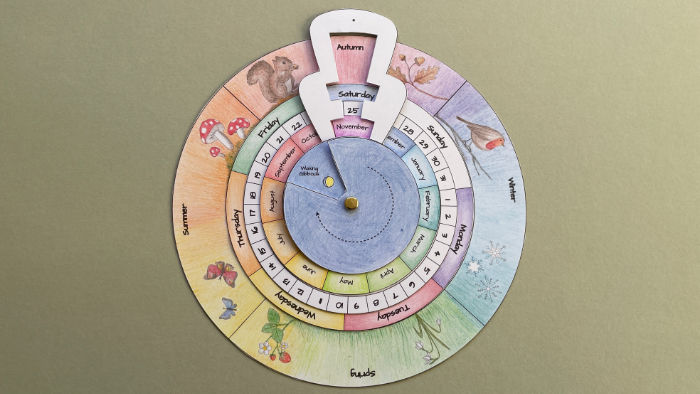
Teaching children about time happens naturally as they grow up, but there are some fun tools you can use to help them understand the concept of time and why we measure it as we do.
One of these tools is the phenology wheel
You divide a circle into four segments, one for each season, and then record in each season what you are noticing in the world around you - in nature as well as in the home. You can do this on paper or even embroider with them on a large piece of fabric or felt.
Talk to the children about what the weather is doing and ask what they are noticing plants and animals doing as a result of the weather. What are we doing as humans? The wheel will help children to realise that it is all connected. The fact that it is designed as a wheel also supports the idea of circular living, the circle and the rhythm of life.
Introduce children to a perpetual calendar
When children are a little older, from about 6 years onwards, you can introduce them to a perpetual calendar which has a phenology wheel as its base and a dial for the days of the month, the weekdays, months and also the phases of the moon that you can move. This helps children to learn how the days make a week, which months make up which seasons, and it helps you to explain how the moon affects life on earth.
Weekday colours
Assigning a colour to each weekday gives a visual stimulus that helps children internalise the rhythm of the week without having to memorise weekday names that can be quite abstract for them. If you incorporate these colours into each day, for example by putting a veil or peg-doll of the day's colour on display and/or getting children to move the dial on the calendar wheel every morning, they can easily remember for example that on purple day they go back to Kindergarten after blue and white days that mean being at home with their family.
The colours for each weekday are not random: the Romans came up with the way we still measure and record time (the 24-hour, 7-weekday system) and named weekdays after celestial bodies (which in turn got their names from Roman Gods). Many languages (French, Italian, German and English for example) have the names planets, the moon and sun within their weekday names.
Monday - Moon - purple
Tuesday/Mardi - Mars - red
Wednesday/Mercredi - Mercury - yellow
Thursday/Jeudi - Jupiter - orange
Friday/Vendredi - Venus - green
Saturday - Saturn - blue
Sunday - Sun - white
Weekday colours in Waldorf education are based on the celestial bodies' colours per Rudolf Steiner, who derived them from Goethe's colour theory and other older traditions such as Greek/Roman astrology (pre-telescopes), so although the colours are linked to celestial bodies, they are not what the celestial bodies actually look like through a telescope.
Where to get a perpetual calendar
You can buy or make your own perpetual calendar. If you have the skills and tools, you can make one from wood, but the easiest and quickest way is to use paper.
I designed this perpetual calendar for my daughter built around a phenology wheel with movable dials for weekdays, months, dates and moon phases. You can download this from my Etsy shop. This printable PDF also includes a blank template so that you can create a calendar with your own drawings (which may also vary depending on where you live).


